
Ask a class to describe a character and you’ll get the same paragraph thirty times: He had brown hair and blue eyes. He was tall. He was wearing a jacket. It’s accurate, it’s tidy, and it tells us absolutely nothing about who this person is.
The fix is sitting in Stave One of A Christmas Carol. Scrooge’s entrance is one of the best mentor texts I know for character description, because Dickens never once tells us what colour Scrooge’s hair is. He makes us feel the cold coming off him instead.
Here’s how I teach it, the four techniques students can borrow, and a free 20-minute activity you can use this week.
The passage
Oh! But he was a tight-fisted hand at the grindstone, Scrooge! a squeezing, wrenching, grasping, scraping, clutching, covetous, old sinner! Hard and sharp as flint, from which no steel had ever struck out generous fire; secret, and self-contained, and solitary as an oyster. The cold within him froze his old features, nipped his pointed nose, shrivelled his cheek, stiffened his gait; made his eyes red, his thin lips blue; and spoke out shrewdly in his grating voice. A frosty rime was on his head, and on his eyebrows, and his wiry chin. He carried his own low temperature always about with him; he iced his office in the dog-days; and didn’t thaw it one degree at Christmas.
Charles Dickens, A Christmas Carol, Stave One (1843)
Read it aloud first, and read it with relish. Students hear the rhythm of that list long before they can name what Dickens is doing.
Four techniques students can steal from Dickens
1. Build the whole character around one trait
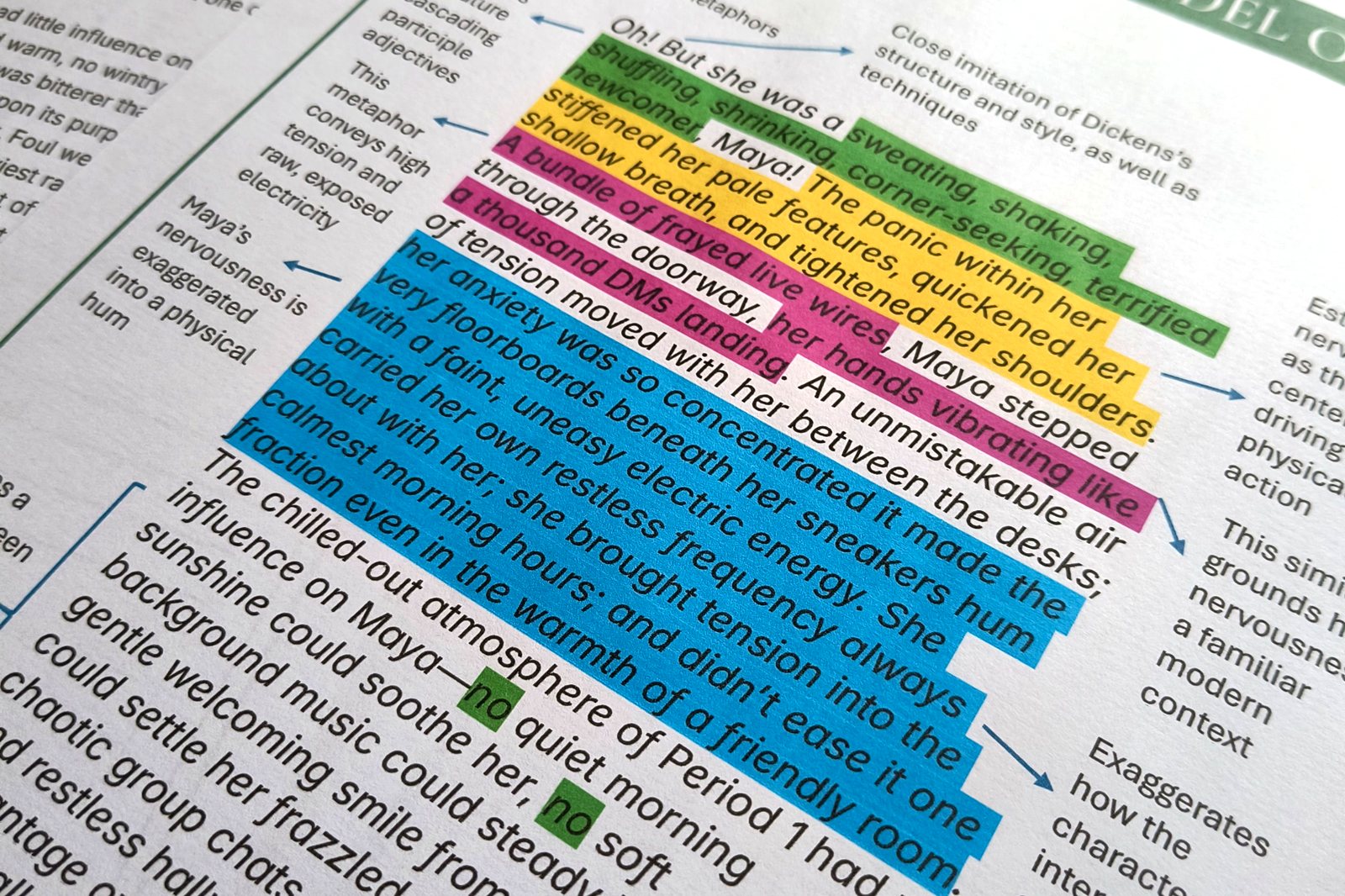
Everything in the paragraph serves a single idea: Scrooge is cold. Not “mean and also a bit sad and quite old”. Just cold, and every detail (the frozen features, the blue lips, the frosty rime) pushes that one idea further. Victorian critics noticed this habit in Dickens: he tends to seize one striking quality and build a whole person out of it.
For students: before writing a word, choose one trait. Every detail must earn its place by showing that trait.
2. Exaggerate the details
Scrooge doesn’t just keep a chilly office. He “iced his office in the dog-days”, the hottest days of summer, and “didn’t thaw it one degree at Christmas”. It’s impossible, and that’s the point. Exaggeration makes the trait unforgettable.
For students: take an ordinary detail and push it one step past believable.
3. Use lists that build
“A squeezing, wrenching, grasping, scraping, clutching, covetous, old sinner!” Seven words, each one tightening the grip. Lists like this create rhythm and pile-up, so the reader feels overwhelmed by the character, which is exactly the effect Dickens wants.
For students: write a list of four or five verbs or adjectives that all point at the same trait, and put the strongest one last.
4. Choose surprising similes and metaphors
“Hard and sharp as flint.” “Solitary as an oyster.” The oyster is my favourite to teach, because students always ask why an oyster. Shut tight, hard on the outside, and you have to prise it open. It’s a whole character arc in two words.
For students: avoid the first comparison that comes to mind (“cold as ice”). Find one that says something about the character’s personality, not just their temperature.
Free activity: the 20-minute Dickens remix
This works as a starter or a full mini-lesson. Students won’t need to have read the whole novel; the passage is enough.
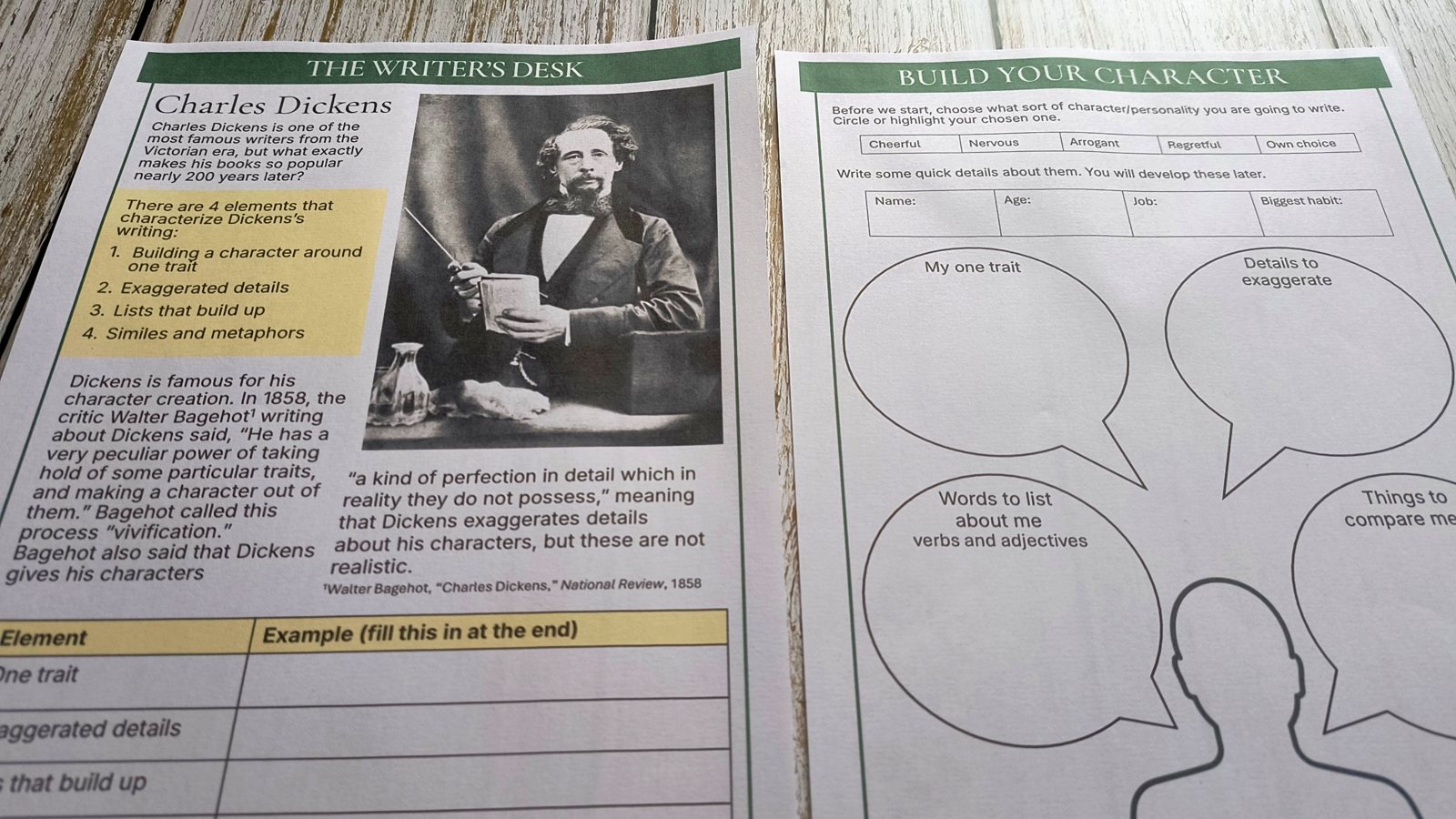
- Pick a trait (2 min). Give each student or pair a trait card: vain, nervous, nosy, cheerful, greedy, boastful.
- Exaggerate (5 min). Write three details that show the trait and push each one past believable.
- List (3 min). Write a list of five verbs or adjectives that build, strongest last.
- Compare (3 min). Write one surprising simile or metaphor.
- Assemble (7 min). Combine everything into a six- to eight-sentence character entrance. Bonus points for opening with “Oh! But she was…”
Here’s a model you can share:
Oh, but she was a vain one, Miss Pemberton! A preening, primping, polishing, admiring, mirror-haunting creature! She carried a looking glass in every pocket, and in a rainstorm she would rather drown than ruin her hair. Her shoes shone so brightly that pigeons mistook them for puddles. She glittered like a shop window at Christmas, and was about as warm. Even her shadow seemed to stand up straighter whenever she passed a window.
Ask students to spot all four techniques in the model before they write their own. Then read a few aloud. The class will happily vote on whose character is the most unbearable.
Tips for teaching it
- Ban the basics. No hair colour, eye colour or height allowed. It forces students straight into personality.
- Hot-seat the character. Once the paragraph is written, a partner asks the character three questions and the writer answers in role. Weak characters fall apart fast.
- Keep Scrooge visible. Leave the passage projected while students write, so they can keep checking their work against the original.
- Link it to the novel. If you’re reading A Christmas Carol, come back to this paragraph in Stave Five and ask how Dickens describes the changed Scrooge. It’s a brilliant way into his transformation.
Want the full lesson ready to go?
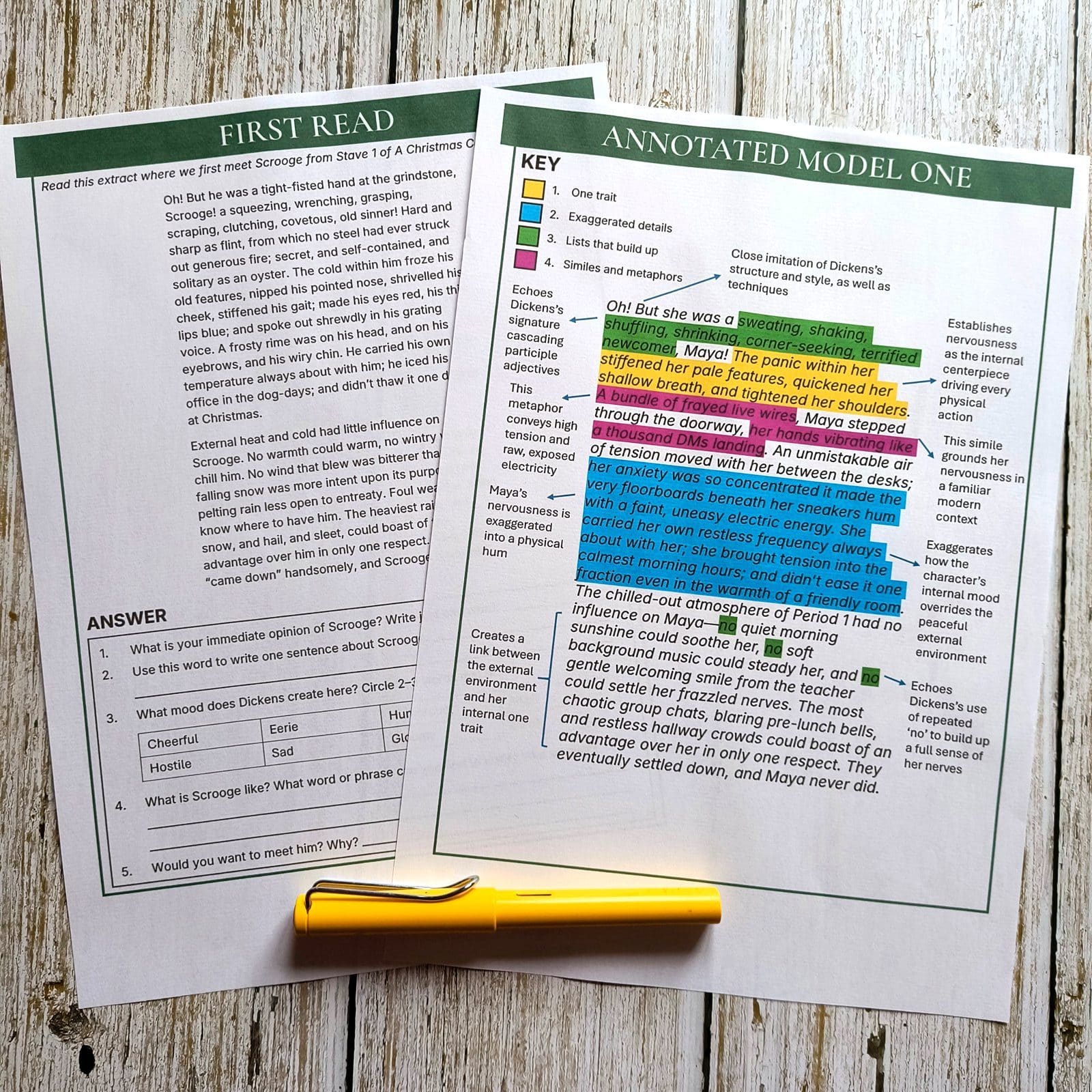
If you’d like this as a complete, print-and-teach resource, Write Like Dickens takes students through three stages (analyse, imitate, write) with a teacher guide, a ready-to-project PowerPoint, student worksheets, two annotated models, rubrics and answer keys.
It’s also part of my A Christmas Carol Novel Study Bundle, so if you already own the bundle, just re-download it from My Purchases to get the new lesson free.
And if you’re building context before you read, my post on Victorian Christmas context in five short sources pairs nicely with this one.
Happy writing, and may your students’ characters be gloriously unbearable.